CD Black Rainbow in Magazine Scherzo - Exceptional
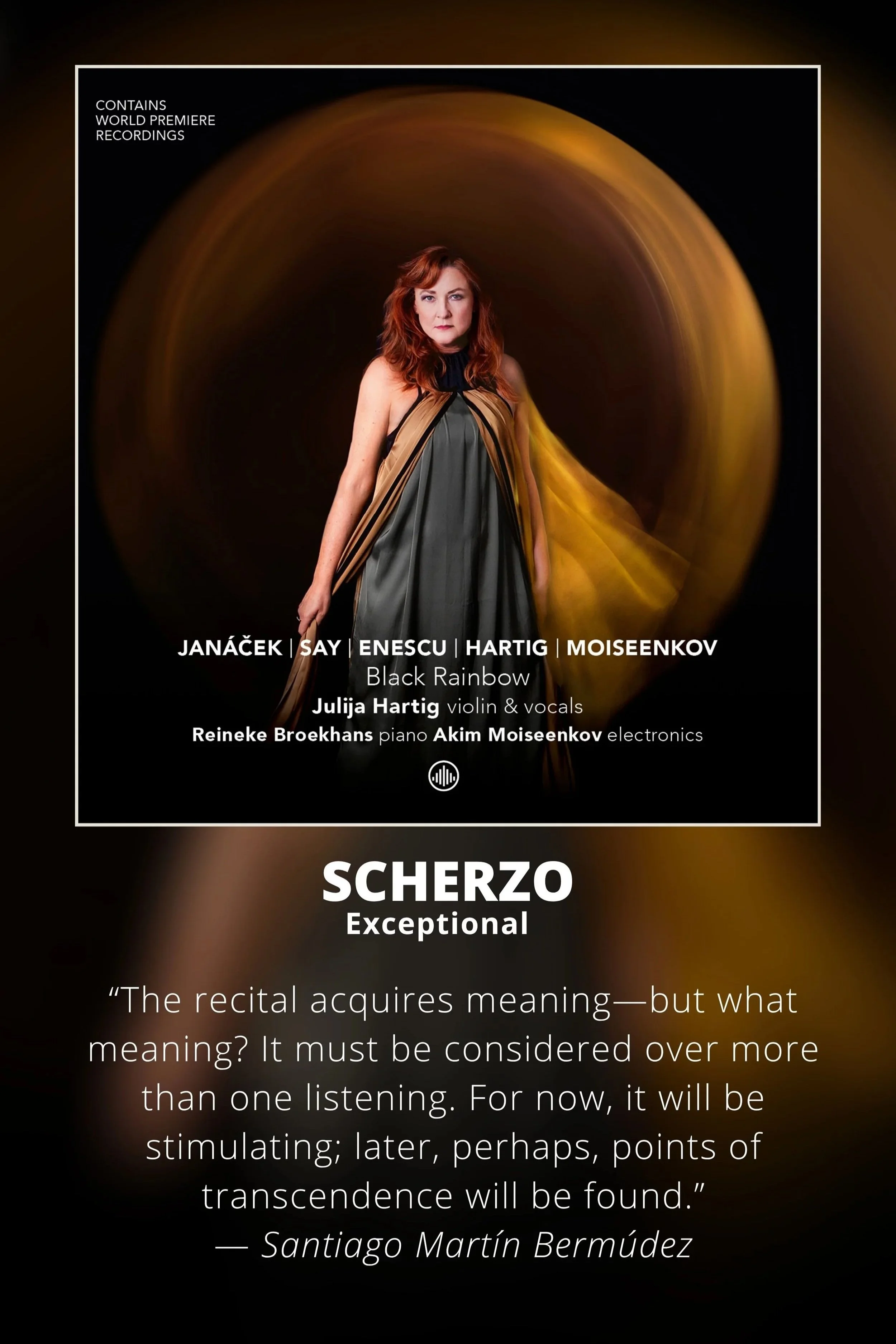
BLACK RAINBOW in Magazine Scherzo
Works by Janáček, Say, Enescu, and Hartig-Moiseenkov. Julija Hartig (violin and voice), Reineke Broekhans (piano), Akim Moiseenkov (electronics).
CHALLENGE RECORDS (1 CD)
Black Rainbow is both a recital and an experiment led by Julija Hartig and Akim Moiseenkov, featuring electronics in the fifteen-minute title track. The program features music from Central Europe and the Balkans, plus Fazil Say—who feels just as close.
The two sonatas Janáček composed around 1879-80 have not been preserved; they were merely exercises. In 1914, "while waiting for the Russians to arrive" (a touch of Pan-Slavic naivety), he composed three movements of another Sonata and added one from the 1880 work as a Ballada. It premiered late, in 1922. There is a risk of perceiving it through a post-Romantic lens, but that is avoided here. The first movement, Con moto, derives its opening motif from one intended for Katja Kabanová; written in a free sonata form, the second theme recalls the Hospodine of the future Glagolitic Mass in its wavering episodes—especially the final Adagio, which showcases Janáček in full modernity. Slightly later is Enescu's Third Sonata, written for himself and, as we now see, for posterity; the astonishing Andante sostenuto e misterioso alone would be enough to justify it.
The Sonata by Turkish composer Fazil Say is situated between the two in this recital. It is an ambiguous work, placing an Andante misterioso as both the first and fifth movements—a near symmetry? The Grotesque and the Perpetuum mobile are explorations into jazz and the obsessive ostinato of minimalism. The Andante (Anonymus) seems like a truce, yet it proposes an enigma. The final Melancholy is not an answer, but perhaps a meditation.
The experiment lies in Black Rainbow, Quo Vadis homini, an incandescent rain that Julija both plays and sings, co-composed with Moiseenkov and supported by his electronics. It is the centerpiece of the CD in terms of its proposal. The recital takes on meaning here, but which...? One must consider it over more than one listen.
For now, it is stimulating; later, perhaps, you will find points of transcendence. The rest is a question.
Santiago Martín Bermúdez