Review - Black Rainbow in Luister Magazine
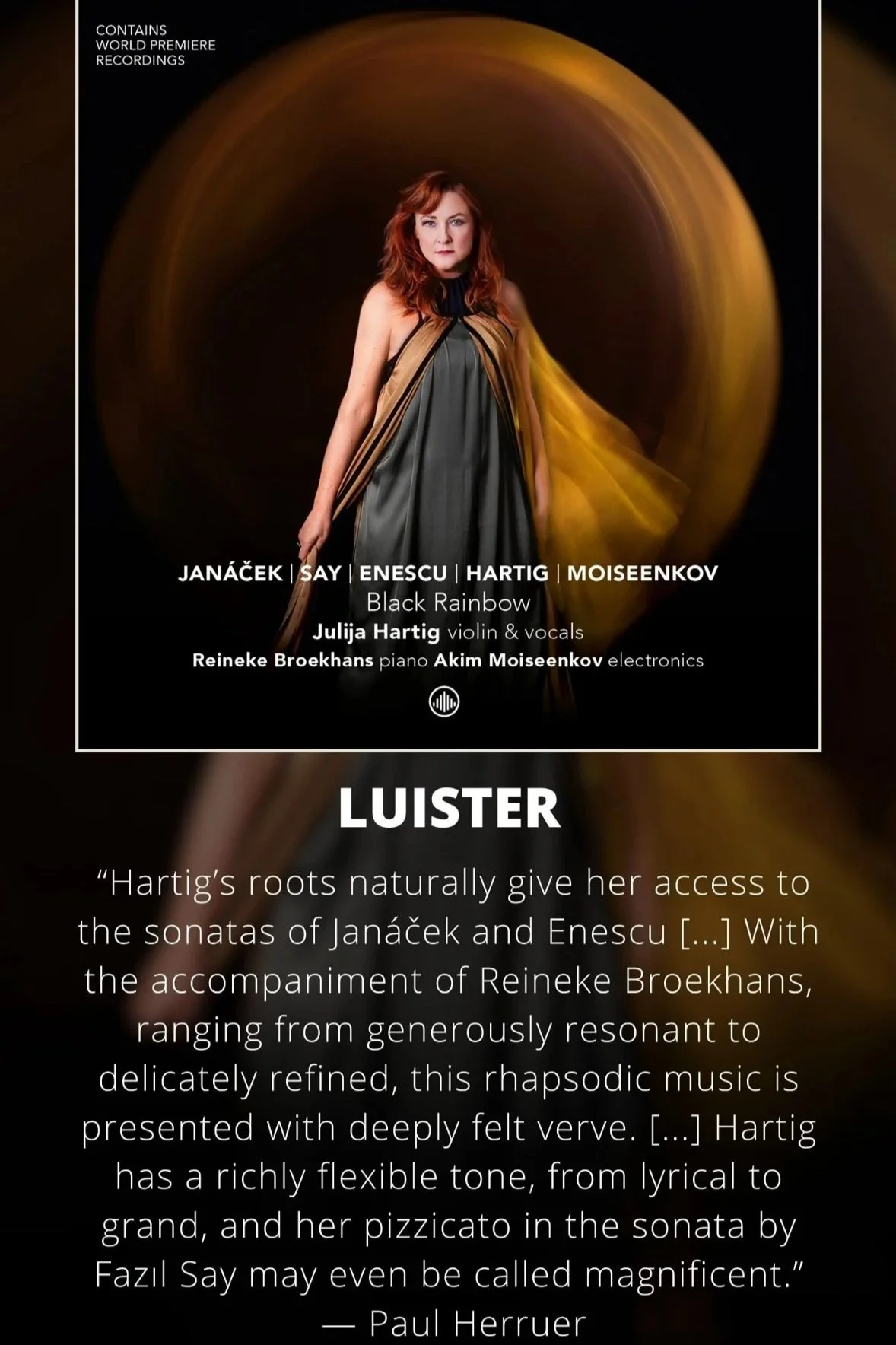
WAARDERING 9,5
Haar debuut-cd Black Velvet werd als een autobiografie in muziek omschreven en nu op Black Rainbow is Julija Hartig daarover niet uitverteld. Ze doet dat met componist Akim Moiseenkov in een stuk waarin zang van haarzelf, haar moeder en over-over-grootmoeder klinkt, viool en veel elektronische klanken; van kosmisch gesuizel tot oorlogsgeluiden. Er zit een verhaal in en het klinkt, maar niet zozeer als zelfstandige muziek. Hartigs roots (Hongaars, Tsjechisch, Slowaaks en Oostenrijks) geven haar vanzelf toegang tot de sonates van Janáček en Enescu en dat horen we ook, en hoe! Met de begeleiding van Reineke Broekhans, van gul klinkend tot ragfijn, wordt die rapsodische muziek met doorleefde verve voorgedragen. Samen nemen ze vrijheden waar dat kan, maar die zijn altijd doelgericht. Hartog heeft een ruim plooibare toon, van lyrisch tot groots, en haar pizzicato in de sonate van Fazil Say mag zelfs imposant genoemd worden. Dat stuk is zeventig jaar jonger dan de andere twee, maar ook hier klinkt Balkan-volksmuziek door, wat gezien de eeuwenlange Turkse overheersing aldaar niet verwonderlijk is. Harmonisch verrassend is Says sonate niet, maar ze is zo nu en dan gewoon mooi. Ze past prima bij Janáček en Enescu, wiens Derde Vioolsonate het hoogtepunt van de cd is.
ENGLISH
RATING: 9.5
Her debut CD Black Velvet was described as an autobiography in music, and now on Black Rainbow, Julija Hartig is not finished telling that story. She does so with composer Akim Moiseenkov in a piece featuring the voices of herself, her mother, and her great-great-grandmother, combined with violin and a wealth of electronic sounds—ranging from cosmic whispers to the sounds of war. There is a story within it, and it resonates, though perhaps not so much as standalone music.
Hartig’s roots (Hungarian, Czech, Slovak, and Austrian) naturally grant her access to the sonatas of Janáček and Enescu, and it shows—and how! Accompanied by Reineke Broekhans, whose playing ranges from lush and full-bodied to gossamer-thin, this rhapsodic music is presented with deeply felt verve. Together, they take liberties where possible, but these are always purposeful.
Hartig possesses a broad, flexible tone, ranging from lyrical to grand, and her pizzicato in Fazil Say’s sonata can even be called imposing. That piece is seventy years younger than the other two, yet Balkan folk music echoes through it as well—which, given the centuries of Turkish rule in that region, is hardly surprising. Harmonically, Say’s sonata is not surprising, but at times it is simply beautiful. It fits perfectly alongside Janáček and Enescu, whose Third Violin Sonata is the highlight of the CD.
PAUL HERRUER